L4. New aspects of Sacred Language, & Nuxalk, Uralic & connected topics, also publ. on: 18/10/2026
Written & published by Linden Alexander Pentecost, published on the 10th of October 2026; earlier today (the 10th of October 2026), I published an unrelated blog post on another of my websites. This publication on this page is unrelated to and separate from any and all of my other publications, and no AI was used in this publication. This article was extensively edited and a lot more material was added on the 23rd of November 2026, and the title was also changed to better reflect the content of this article. The photo in this article was also taken by myself, the author. This article was published in the UK, on this UK website, and contains a total of 3465 words. All of its content is unrelated to and separate from any of the content in any and all of my other publications.
I have discussed the Nuxalk language extensively in other publications, and the Northern Sámi language arguably even more so. The content in this article builds upon that earlier work and adds further details to it. Before I go on to deeper linguistic discussions, I want to briefly discuss some of the petroglyphs connected to the ancestral Nuxalk, for example, those of Thorsen Creek in the Bella Coola area. The Thorsen Creek petroglyphs show various holy figures from Nuxalk culture, including Qwaxw - "Raven", and the Syut - "Orca", whilst the site also shows spiral-like markings, perhaps depicting deities - but this specific information is generally kept private by the Nuxalk. What I will say is that some of these other motifs at Thorsen Creek, whilst not strictly being cup marks and spirals - do in many senses contain a similar geometry and form to the spiral and cup marks of Northern England for example, including to some of those at Ilkley Moor in Yorkshire, and also show some similarities to the Neolithic petroglyphs, for example, of Barclodiad Y Gawres in Wales, Newgrange in Ireland, and other similar passage tomb sites in Brittany. I will have to do more research into which Petroglyph sites in England might show the greatest similarities to those of the Pacific Northwest. Another fascinating point is how, despite these similarities, the Nuxalk petroglyphs at Thorsen Creek nevertheless express unique geometric forms that resemble and relate to the contemporary carving forms and art found among Pacific Northwest Indigenous Peoples in contemporary times, with the Thorsen Creek Petroglyphs, in my observations, and not surprisingly, having great similarities to the carvings and paintings of western Salishan-speaking and Wakashan-speaking peoples. These carvings commonly appear in longhouses among the aforementioned peoples, and also on other sacred objects. In many respects the petroglyphs can be thought of as an eternal-time or deep-time manifestation of the same sacred markings that the Nuxalk and other peoples continue to create to this day, in much the same way that the Nuxalk and other Salishan and Wakashan continuing into the present, can perhaps be thought of as "emanations" of the same, timeless, universal geometry and language, that physically and symbolically manifests through petroglyphs. We can probably learn a lot from what Pacific Northwest Indigenous peoples (but not the Nuxalk) describe about - specifically the spiral and cup-mark petroglyphs that their ancestors created. For one it seems that they were connected to marking, and connecting to vision quests. Secondly, they seem to serve as acoustic resonators, where knocking a stone into the centre of a cup mark opened the portal for communicating. This idea resembles my own studies on many related topics, including an Estonian folklore account of how a man uses a copper rod, and how gently knocking it against a stone enables him to "call" an elven ancestor of the Underworld. With regard to my comments below - please note that I have written extensively about other aspects of petroglyphs, ancient writing, and ringing stones, recently in unrelated publications.
Of course on no account should anyone ever use or do anything to these petroglyph sites in America, firstly so not to damage them, secondly because messing with such powers without having been taught the indigenous knowledge by the exact right tribe, clan and family, would be disrespectful, stupid and spiritually dangerous. Another thing is that, like in Ireland, where stones were used by witches in such holes or cup marks - it is implied that Northwest Pacific peoples used these sites to influence weather, and also to map celestial objects and cyclical changes in nature - not that either of these necessarily correspond to the over-simplified, westernised "need" to try and connect all of these markings to star systems and planetary movements, or solar movements from our modern perspective, where we imagine "Space" as an empty space and do not imagine the cosmos as something far more intricate and less linear, like our ancestors believed and understood. In terms of copper rods being used to communicate with spirits, I have discussed this elsewhere alongside an example from Cornwall, and the Estonian example, both in detail and across different publications, and I have discussed similar things being described elsewhere. But I will also briefly say here how this connects with what the book Akhbār al-zamān (a book with many authors, most unknown) says about how the Ancient Egyptians moved stones to build the pyramids. I have written about these things extensively, usually from the acoustic resonance angle, but in Akhbār al-zamān, the "linguistic" element is implied not just to be acoustic, but was described as being some kind of spell or charm in hieroglyphs, written on a piece of papyrus and placed under the stone. I think perhaps that the metal rod was then used to gently strike the stone in order to somehow "activate" the language in the hieroglyphs on the papyrus. Fascinatingly, there are also theorists out there who believe the reason our electronics "work" is not down to simple physics, but down to the linguistic, geometric "power" of particular cross or other symbols that are used within electronics, although of course if these are an element then they are poorly understood and unproven. I have also discussed some aspects of this in Silly Linguistics magazines, including in my next upcoming one. The exact quote by Akhbār al-zamān is as follows:
"They brought sheets of papyrus covered with inscriptions which they placed under the stones; then they struck the stone with a copper rod, and immediately the stone rose into the air and crossed the space of a bowshot (about a hundred cubits). They repeated this operation until the stone arrived at the desired place."
You can see how the quote aligns with my earlier comments above it and with my earlier publications. That copper is relevant in electrical flow is probably no coincidence, and it is perhaps no coincidence that Väinämöinen in Finnish mythology sung into existence a boat made of copper, which is also something I have extensively discussed elsewhere. This subject also leads us back to the Nuxalk, and to their deity of the Undersea World, known as Q'umakwa. Not only is Q'umakwa associated with copper, but from what I understand, this deity is associated with sacred whistling, with some Indigenous American peoples associating whistling and flutes with the language of spirits. This also connects with copper rods and their resonant capabilities, and perhaps with the metal "tubes" through which the Urals mythological "Zolotaya Baba" is said to speak through, according to the folklore of the Urals in Russia. More widely this can be associated with the taboo of whistling - due to the danger that it can call spirits, a motif that is specifically described in association with a metal flute in some stories, including in fictional stories such as the story titled: "Oh, Whistle, And I'll come to you, my lad", by the author M. R. James.
Furthermore, like Q'umakwa, Väinämöinen is also associated with the sea, and with language, and whilst Q'umakwa is sometimes associated with having an octopus-like appearance, some accounts of Finnish mythology imply that the sometimes octopus-looking Finnish deity Iku-Turso, is actually the father of Väinämöinen. These similar ideas relate to ideas further down this page about some similarities between Uralic and Salishan linguistically - which I have discussed elsewhere, though which I do not specifically go into here. I have also discussed Väinämöinen and Iku-Turso a great deal elsewhere. It is also noteworthy that, whilst the Nuxalk did not strike copper rods for spirit communication, they did use copper in some spiritual ceremonies.
The Nuxalk language is known as It7Nuxalkmc with the 7 representing a glottal stop in Nuxalk. Nuxalk is known for its extreme consonant clusters, even among Salishan languages, for example “hummingbird” is xwnxwnm. “tree” is stn, “mountain” is smt or smnt, qw’litq means “seagull” and ts’lkt means “a bald eagle”. I remember a few months ago, when in a pub and blissfully happy in talking, I said something like "Oh I love hummingbirds, they are so cute... a hummingbird is like really small, cute beak, fast moving.." and then another person replied "you believe I don't know what a hummingbird is", in a gentle way, and I immediately apologised with "oh, no, I'm sorry I didn't mean to assume", not that the person actually was annoyed with me, it was a jokey and light conversation. This paragraph serves as a kind of re-introduction to the language.
Nuxalk is quite divergent compared to other Salishan languages, but like other coast Salishan languages for example, Nuxalk sometimes uses similar phrasing to some Indo-European languages, along with there also being other similarities. For example ti smnt tc n ti tsalh tc - “the mountain and the lake”. The phrase ti smnt tc means something like “the mountain”, ti is a masculine deictic prefix, somewhat akin to an article, whilst tc is the corresponding deictic suffix. The word n means “and”, and ti tsalh tc translates to “the lake” in this context. Verbs in Nuxalk generally come before nouns, with the language generally having a VSO or “verb-subject-object” word order. For example: tl’ap ti Qwaxw tc - “the Raven goes”, literally tl’ap “goes”, ti Qwaxw tc - “the Raven”. , anayk tsi cnas tsc ska ksnmaks ala tsalh ts - “the lady wants work at the lake”, from anayk - “want(s)”, “intend(s)”, tsi cnas tsc - “the woman”, ska - a “particle” which implies a future intension, whilst also meaning something like “that” in this context, ksnmaks - “he/she/it works”, ala tsalh ts - “at the lake”. The part: ska ksnmaks together means something like “that she works”, but this is how this kind of sentence would be generally phrased in Nuxalk. In general it means something like “intends the woman that she works at the lake”. The word ska is built from ka which also implies future intention, with the addition of the migratory initial s in Nuxalk, for example ka slaxaw wa stn ts ala smnt t'ayc - "there will be a lot of trees at the/this mountain", ka - "will be/future", slaxaw - "a lot", wa stn ts - "trees", ala smnt t'ayc - at the/this mountain". Another example using ka would be axw ka slaxaws wa cnas ts ala anuxum ts alh ti suncwt - "there will not be a lot of women at the river today", from axw - "not"/negative particle, ka - will be/future particle, slaxaw - "a lot", which becomes slaxaws with the -s (third person singular) here implying a subordinate clause, triggered by the negative axw, wa cnas ts - "women", from cnas - "woman", ala anuxum ts - "at the river", alh ti suncwt - "today".
Whilst Nuxalk nouns in standalone forms can illustrate a grammar in Nuxalk that is in many respects akin to that of Celtic, Germanic or some Afro-Asiatic languages for example, Nuxalk is also a very polysynthetic language when it comes to its verbs. Nuxalk possesses for example suffixed forms of many nouns, which exist alongside, and help to form larger nouns. For example a “boat” on its own as a standalone noun is lhalas. However, there is also a specific suffix meaning “boat”, which is -ulalh, so if one was to say “I build a boat”, it could be expressed as tamulalhts, which is from the roots tam- - “to do” or “make”, -ulalh - the suffix for “boat”, and -ts the first person singular suffix. Suffixes in Nuxalk can be much more complex, and incorporate multiple ideas and meanings. Another suffix is -ulhiixw - “head hair”, which can be formed into the verb ts’xulhiixw - “having white hair”. There are a high number of suffixes in Nuxalk, not all of which are used to form nouns, for example the -tum suffix which turns a noun or name into the main verb in a sentence, and acts as a causative suffix, e.g. Dave-tum ti smatmcts (tc) - "Dave is my friend", ti smatmcts (tc) means "my friend", from smatmc - "friend", plus the first person singular suffix, thus smatmcts - "my friend".
Verb suffixes in Nuxalk also incorporate both the subject and object “pronouns”, for example “I make them” is tamtits with the -tits suffix being specifically for an action done by the first person singular and relating to the third person plural. To say for example “you make” and “you make them”, this would be tamnu - “you (singular) make”, with -nu being the second person singular “pronoun” suffix, whilst “you (singular) make them” would be tamticw, with -ticw being the suffix incorporating the “pronouns” you singular, as the doer, and “they” or the third person singular as the “pronoun” the action relates to. These polysynthetic verb forms can also be incorporated with standalone nouns, for example tamticw wa sulh 7ats - “you make these houses”, literally “make(you-them) (the) houses (these)”. Nuxalk does not have plural forms of nouns in the strictest sense, but the particle wa and also the deictic word 7ats indicate that sulh - "house" is plural. Another example would be: k'ctits wa smlhk 7ats - "I see the fish", from k'c - "to see", k'ctits - I see them, with the -tits suffix being for when the first person is the doer of the verb, and the third person plural is the object, wa - plural particle, smlhk - "fish", plus the deictic word 7ats.
In this article I am also going to discuss some tree words in Sámic and Finnic languages. Note that in Nuxalk, "tree" is stn. Nuxalk is of course not related to Uralic languages, although there are some similarities between Salishan and Uralic languages. Another possible Salishan - South American similarity I would like to bring up briefly, first, is the Nuxalk word syut means both an "orca" and a "song", and "spirit". I have pondered whether or not this word is related to Quechua suti - "name" or "truth", e.g. sutiy Linden kan - "my name is Linden", or, sutiyqa Linden - "my name is Linden" (more roughly translated). Note that I have commented elsewhere on the use of s in Nuxalk, which serves a number of purposes, as well as being the third person singular marker and "pronoun", and how the use of s in other places in Nuxalk bears similarity to the migratory initial s- in "Indo-European" languages. Of the various theories as to why this exists in Indo-European languages, I find the idea that the s- makes a semantic/sound symbolism difference to be a possibility that makes a lot of sense to me, whilst the idea of the s- being an agency or even causative marker also makes a lot of sense to me, and as I have commented elsewhere, I think it likely that the s- certainly implies some kind of verbal action, and meaning of "it is", somewhat like the use of is - the copula in Goidelic languages, which does fit into the sound symbolism theory, but this can I think simultaneously exist alongside the idea that the s- is a copula and marker of agency marker/an agentive indicator, somewhat like -tum in Nuxalk.
Moving onto Sámi languages: the Northern Sámi word for "tree" is muorra. Note that the rr in this word is strongly rolled by speakers of certain dialects of Northern Sámi. Other forms of this same root word are found in other Sámi languages, although the word may not be "Uralic", per-se, and only occurs rarely in Uralic languages outside of the Sámi languages. Similar words occur in other, unrelated languages, which I have discussed elsewhere in relation to these Sámi forms.
The Northern Sámi word for a rowan tree is skáhpi. The Lule Sámi word for "rowan tree" is skáhpe, whilst the Southern Sámi word is raavnije, the Southern Sámi form being from a different root - that connected to Norwegian rogn - "rowan". The Inari Sámi language uses the word pihlejâš for this tree, whilst in Skolt Sámi, the word is råʹšnn. The Inari Sámi word must be connected to Finnish pihlaja- "rowan tree", although rauni is a beautiful and more poetic name for a rowan tree in Finnish, Rauni is also used as a title for the Goddess of the Rowan Tree, who in Finnish tradition is considered to be the wife of Ukko, the thunder god. The Sámi name Ravdna is related and is also connected to Rowan trees.
In Finnish tradition, some other trees can also have multiple names. The Scots pine tree, or a pine tree more generally, is known as mänty in Finnish. But the word honka refers specifically to an ancient pine tree that stands out and is significant in some way. Another Finnish word for a "pine tree", or specifically for a Scots pine tree, is petäjä, which is itself related to Northern Sámi beahci. Below are a couple of examples of Finnish sentences I have written to discuss some of these tree names:
1. Nuo hongat ovat korkeimpia asioita koko maisemassa - "those old pines are the highest things in the whole landscape"
nuo - those, plural of tuo - that (distant), hongat - plural of honka, ovat - are, korkeimpia - partitive plural form of korkein, which is the superlative form of korkea - "high", asioita - partitive plural form of asia - "thing",, koko - "all (of)", maisemassa - "in the landscape", inessive form of maisema - "landscape".
2. Syysvärit näkyvät ikivanhoista metsistä - "the autumn colours show (themselves) from the ancient forests"
syysvärit - "autumn colours", from syys- "autumn", värit - "colours", plural of väri, näkyvät - they show (themselves)", plural present tense form of näkyä, ikivanhoista - elative plural form of ikivanha - "ancient", metsistä - elative plural form of metsä - "forest".
Photo below: beautiful autumn colours on a mountainside above Abisko, this scene reminds me a little of some of the scenes in "The Hobbit" films, it reminds me especially of the scene where Bilbo climbs one of the trees of Mirkwood, to get a view over the landscape of autumn leaves, with beautiful butterflies stirring and flying across the canopies. In fact, if we compare Middle Earth to Europe, Mirkwood, originally known as Greenwood The Great, "might" correspond in some way to the vast forested regions around what is now the Baltic and Northern Scandinavia and Finland. Similarly, the "Iron Hills" to the east of Mirkwood could for example correspond to the magnetite geology of the Kola Peninsula, Magnitogorsk in Southern Urals or Kursk Magnetic Anomaly. And we all know of the mysterious similarities between the Finnish language and Tolkien's Quenya Elvish language. I feel that whatever magic Tolkien was connecting to, one can still feel it, and the same of ancient adventure, in Lapland/Sápmi. Note also that massive magnetite deposits exist around Kiruna and Jellivaara,
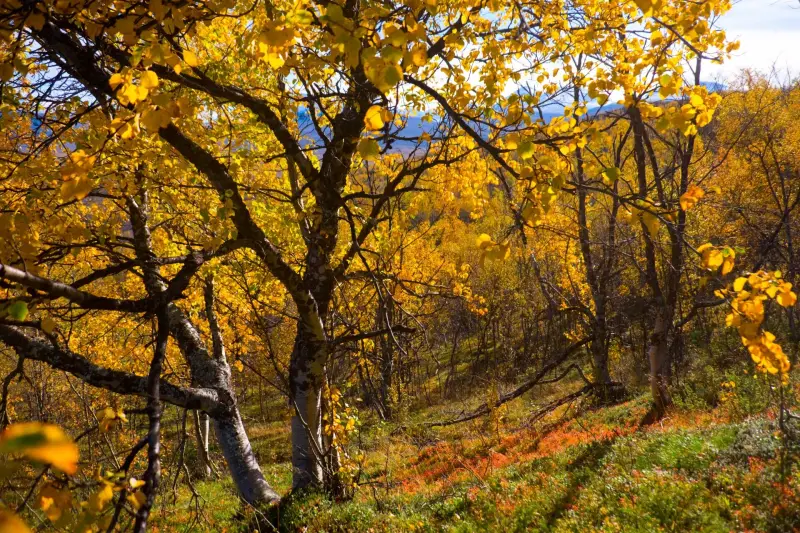
In terms of tree names in the Quenya language, I remember that the Quenya word for a "rowan" is farnë (1), whilst the word for a "birch" is hwindë (1). Note that farnë has some interesting similarities to the word "fern" in English, and for example to German Farn. Could this perhaps be because the shape of the leaves of the rowan or mountain ash tree resemble those of a fern? Tolkien's languages incorporated a lot of real world sound symbolism and etymologies, and I have written about a great many examples of these elsewhere. Of course the general word for "tree" in Quenya, is alda (1), whereas one of the two name for "autumn" is lassewinta (1), which literally means "leaf blowing" (1).
(1) - Quenya words, at eldamo.org
This article was written in honour of the Nuxalk and Sámi, and of other indigenous peoples mentioned. I wrote the Nuxalk and Finnish sentences in this article, and I am confident that they are all accurate.