L3. More on linguistic similarities between Europe and SE USA, publ. on the 27/09/2026
Written and published by Linden Alexander Pentecost, and published on the 27th of September 2026. No AI was used in this publication nor in any of my written works, and this publication is unrelated to and separate from any and all of my other publications. This article was published in the UK. The third photo was taken by me, the author, I have published another version of this photo elsewhere, in an unrelated publication, wherein I discussed other aspects to this topic, not discussed here. I also took the fourth photo, which is of an inscription found at a moundbuilder site. Although I discuss a fair bit to do with Yuchi religion and to do with ancient symbols and writing in this article, note that other aspects and examples of this, with other drawings of possible ancient scripts, will be discussed in an unrelated article with separate content, which will be centred around the Yuchi language itself and which will be published in Silly Linguistics. This article (the article on this page) contains a total of 3165 words. Note that this article uses in-text references and citations and contains a total of 4 images.
In this article I primarily discuss linguistic similarities in terms of symbolic language, ancient inscriptions and folkloric theme similarities in language. I have discussed many other aspects to these before, and here will discuss more in relation to the Moundbuilders in North America and to Europe. The Yuchi people are a people I knew very little about until recently, but to begin, I have recently noticed many similarities and connections which appear to connect them to mythological themes in parts of Europe, as well as mysteries about their symbols, and connections with the Moundbuilders and their examples of writing. In my upcoming, unrelated Silly Linguistics article, I discuss the Yuchi language itself, and other examples of ancient written language, and Yuchi symbolic language, that tie in more closely with the Cherokee and their script, as well as elsewhere (e.g. similarities with Ogham and with twig-runes); whereas I do not cover my research on how this links to the Cherokee in this particular article - not to a great degree. One example I would like to begin with is how in Yuchi tradition, the cedar tree is important in medicine, and the origin story behind this, pertains to a supernatural “wizard” figure.
This legend bears similarities to a story as told in the K’iche’ Mayan Popul Wuj, an epic creation story of the K’iche’ people in central America. It is described in the Popul Wuj how the hero Hun Hunahpu’s head is placed onto a tree; I have described this in detail in other publications.
The Yuchi legend is quoted below, as collected by Albert Gatschet in 1885, and is today also published on the page: www.native-languages.org/yuchistory.htm . Only a part of the original text is included below, to describe the specific things I am discussing in this article:
the Unknown selected two men to make the ascent, gave to each a club, and instructed them that as soon as the wizard who was playing these tricks on the sun was leaving his cavern in the earth and appeared on the surface they should kill him on the spot. "It is a wizard who causes the sun to go so fast. in the morning, for at sunrise he makes dashes at it, and the sun, being afraid of him, tries to flee from his presence." The two brave men went to the rising place of the sun to watch the orifice from which the sun emerges. The wizard appeared at the mouth of the cave, and at the same time the sun was to rise from another orifice beyond it. The wizard watched for the fiery disk, and put himself in position to rush and jump at it at the moment of its appearance. When the wizard held up his head the two men knocked it off from his body with their clubs, took it to their tribe, and proclaimed that they had killed the sorcerer who had for so long a time urged the sun to a quicker motion. But the wizard's head was not dead yet. It was stirring and moving about, and to stop this the man of mysterious origin advised the people to tie the head on the uppermost limbs of a tree. They did so, and on the next morning the head fell to the ground, for it was not dead yet. He then ordered them to tie the head to another tree. It still lived and fell to the ground the next day. To ensure success, the Unknown then made them tie it to a red cedar tree. There it remained, and its life became extinct. The blood of the head ran through the cedar. Henceforth the grain of the wood assumed a reddish color, and the cedar tree became a medicine tree.
Another version seems to describe this wizard figure as instead being a giant serpent. The following is quoted from Yuchi Myth: The Creation Of The Earth From Myths and Tales of the Southeastern Indians By John R. Swanton 1929:
The people wished to find their medicine. A great monster serpent destroyed the people. They cut his head from his body. The next day the body and head were together. They again slew the monster. His head again grew to his body. Then they cut off his head and placed it on top of a tree, so that the body could not reach it. The next morning the tree was dead and the head was united to the body. They again severed it and put it upon another tree. In the morning the tree was dead and the head and body were reunited. The people continued to try all the trees in the forest. At last they placed the head over the Tar, the cedar tree, and in the morning the head was dead. The cedar was alive, but covered with blood, which had trickled down from the head. Thus the Great Medicine was found.
We can also see similarities between the Yuchi story and the Norse mythological story regarding Odin gaining knowledge from Mímir’s head, which is still alive, despite being severed. Mímir is a giant in Norse mythology. Another comparison can be seen with the legend of Vipunen in Finnish mythology. Fascinatingly, whilst the Wizard figure in the Yuchi story has his head carried to different tries, and eventually to the Cedar tree, Vipunen is described specifically as having many trees growing from his body, the specific trees seemingly possessing some symbolic meaning. Vipunen is not described specifically as having his head removed, but like the Wizard of the Yuchi story, and like Mímir, Vipunen is described as though a kind of zombie, alive despite being in a physical state that is no longer “alive” in the traditional sense. I discuss more on this later. Note also that I have discussed Vipunen and his magic words in another way, and in another context in an unrelated Silly Linguistics article. There are also similarities to the Oni in Japan, in terms of their head being removed but remaining alive.
Photo below: a drawing that I did, of a Cox Mound style “looped square” symbol as drawn closely from actual examples. Note the similarities between the symbol in the image below, and the symbol in the image below the image below, and next photo description. The birds are visible as coming off the four sides of the symbol below too.
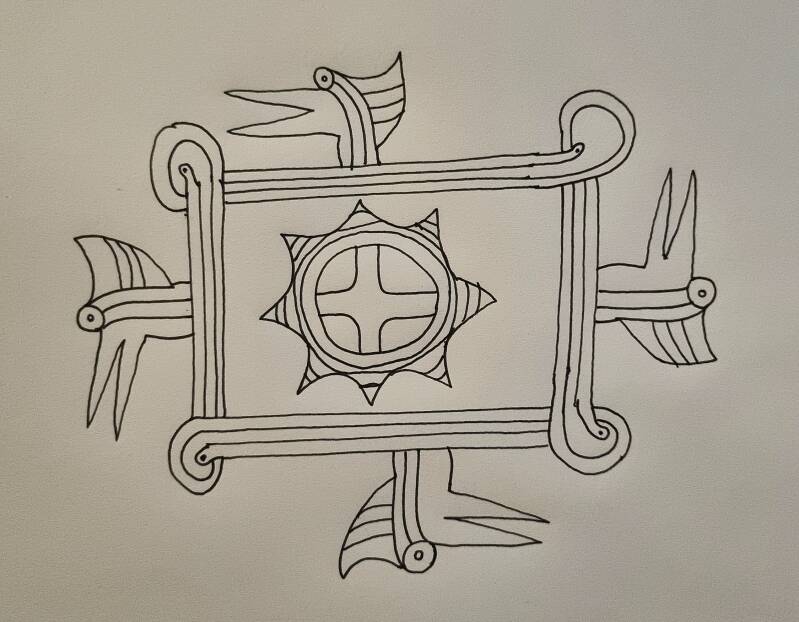
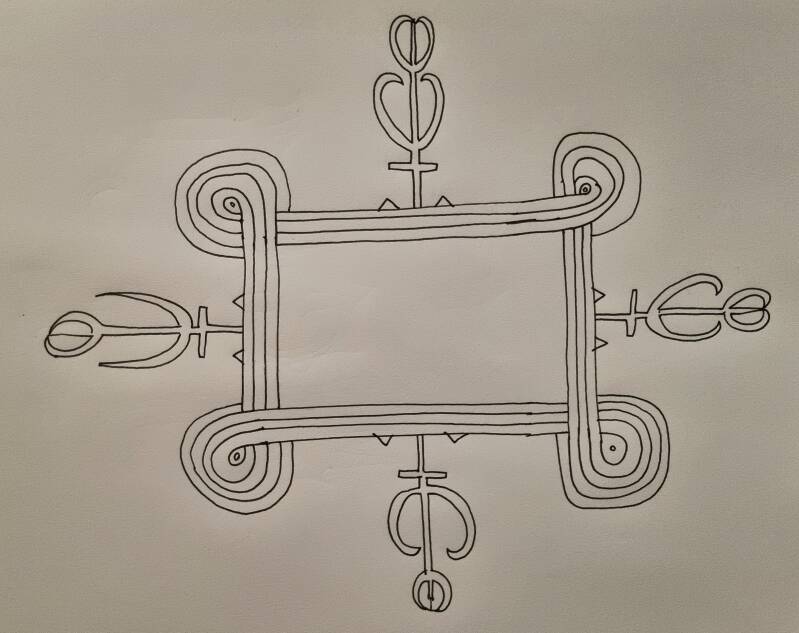
Photo below: left: a drawing I did, of a Finnish Hannunvaakuna design, as depicted on a cheese mould at the National Museum of Finland, Suomen Kansallismuseo, in Helsinki. Note the striking similarities between the symbol in the photo above and that in the photo below, even down to the specific use of the three thick “lines” or components that make up three distinct threads along the sides of both the Finnish and Cox Mound symbols. The use of three “threads” in Finnish examples dates back a fair way, as attested by examples found at Hämeenlinna Castle in Finland. (I have also written about Hämeenlinna Castle elsewhere in terms of its name and its polygonal masonry). Note that this version of the Hannunvaakuna below is not the same as that included in an unrelated article on this site, the style is different and the one in the other article is coloured, and was made with red ochre and blue pastels on black paper, and has a symbol in the centre, like in the Mound Builder example above, whilst the example below is on white paper, done with black lines, and its shape is somewhat different or has differences.
Yuchi is not similar to Finnish or to any Indo-European language, nor to Mayan languages to my knowledge (see my later comments on symbols at Natchex, however). But, at the level of this “wizard” archetype, and the idea of the severed head, there are similarities, and it is possible that a kind of symbolic linguistic link manifests through and in relation to the archetype of this ancient wizard figure.
One of the most well-known sacred symbols of Finland is known as the Hannunvaakuna, a symbol which is commonly ascribed the title of being a form of “Looped Square”, a rather uninspiring name. These symbols are found in various parts of the World, including in Norse iconography, and with different representations found elsewhere, including in the Americas. The specific Finnish Hannunvaakuna or “Hannah’s Insignia” - is however very similar to the “looped square” symbol found on shell gorgets (a kind of pendant made of shell), found in association with ancient mounds, in Northern Alabama and in Tennessee. These examples are described as having the Cox Mound gorget style, named after one of the ancient mounds. The Cox Mound style “looped squares” bear a striking resemblance to the Hannunvaakuna symbol of Finland, particularly to certain versions of it within Finland.
I have published about the Cox Mound “looped square” style elsewhere, in relation to the Natchez language, to moundbuilders, and with examples of possible similarities between Natchez and Uralic; Natchez being another language isolate associated with the moundbuilders in this area. However, in the Cox Mound “looped squares”, we see the heads of four birds, placed around the symbol. In Finnish versions of the Hannunvaakuna these seem not to be birds, but as other symbols. But - the four birds on the Cox Mound “looped squares” may pertain specifically to the Yuchi myth of the four winds, with the sun-like symbol in the centre perhaps being connected to the Yuchi concept of one of their sacred names, the already mentioned Tsohaya, and to their relationship with the sun. We know that the Finnish version of the symbol was used for protection, and that a possible Yuchi interpretation of the Cox Mound style symbols, may be representative of the four winds and of divine origin, in Yuchi tradition. Note that I also discuss and include an unrelated image of the Hannunvaakuna in an unrelated article on this website, titled: m1. More on The Great Mystery of the Cosmos and of Romance - and one Welsh, and one Finnish, symbols, the link to which is: https://www.clwaideac-na-cuinne.co.uk/articles-about-spirituality-language-m1-to-m18/m1-more-on-the-great-mystery-of-the-cosmos-and-of-romance-and-one-welsh-and-one-finnish-symbols . I also discuss something in the aforementioned publication of connections to Indigenous American symbols.
But what is the greater symbolic language that explains how these symbols might be so similar, and what their greater meaning is? And does it relate somehow to these common mythological threads, regarding a wizard’s, or giant’s head? Whilst not purely symbolic language, it is also noteworthy that both Mímir and Vipunen express sacred language according to mythology, with Mímir providing wisdom, and Vipunen giving sacred root words or key words. Both Mímir and Vipunen are also described as giants. You might be thinking, “not a big deal”. But it gets strange, because the Moundbuilder cultures, who were in contact with and connected to the Yuchi and Natchez, and therefore to the Yuchi story about the Wizard’s Head and the Cedar Tree - are also associated with ancient giants. And there are notable reports of giant skeletons being dug up at Moundbuilder sites! Oh, and that’s not to mention mounds and other ancient sites in Germanic areas, which are also associated with giants.
Whether we believe the stories about ancient giants being dug up in America and in Europe, that is up to the individual. But to me at least, it does seem as though there are common threads of linguistic, symbolic and religious ideas within these cultures, which point back to the idea of “giant wizards” who could not die, even when decapitated, and there is also a partial crossover between these influences, and stories of “giants” being buried in mounds, in both North America and in Europe. As I mentioned and have discussed in detail elsewhere, there are some similarities between Natchez and Uralic, e.g. Natchez a’puyv - “head”, we’tv - “day”, tuku’r - “stars”, wa’rv - “sea”, húka - “sand”, which can be compared to Finnish pää - “head”, vuosi - “year”, tähti - “star”, järvi - “lake”, and hiekka - “gravel” or “sand”. I have discussed other similarities between these languages in another publication.. Many similar root word similarities can be seen with other indigenous languages in North America, albeit not with all by any means, but it is unlikely that any “common language” was behind these similarities. Whether or not a linguistic, and symbolically linguistic influence by ancient giant wizards, might have contributed, who knows? (The first 4 Natchez words are from source: Brinton, Daniel Garrison. (1873). "On the Language of the Natchez". Proceedings of the American Philosophical Society. 13 (90): 483–499., the fifth Natchez word in this article (on this page) is from: Bright, William and David L. Olmsted. 1959. A Shasta Vocabulary. Kroeber Anthropological Society Papers 20: 1-55 (Shastan languages are unrelated to Natchez but Natchez is discussed in the aforementioned publication.
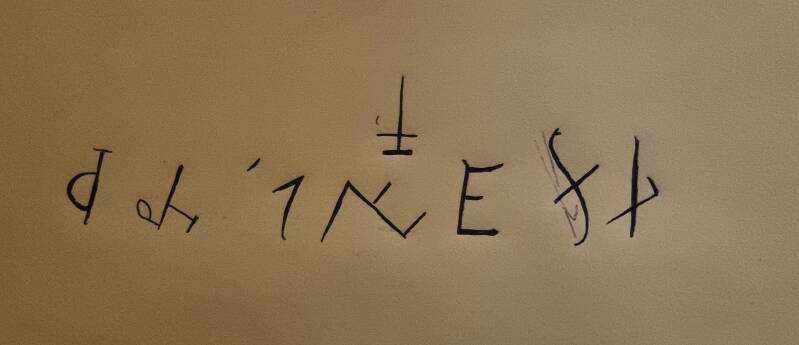
Another fascinating aspect to this which I noticed, was how certain examples of inscriptions found at Moundbuilder sites, show similarity in characters to some of the ancient forms of writing, or what people more commonly refer to as Proto-Writing, in Europe. I think often the term "proto-writing" is used, simply because it is so unacceptable to mainstream academia that prehistoric peoples in Europe could have had written language, despite there being I think a wealth of evidence, which I have discussed in many places, of what most obviously looks like writing. I have discussed a wealth of examples from Orkney in particular, one of which, one of those examples found at Banks Chambered Tomb (a Neolithic tomb) on Orkney, is in the photo below. Below the photo below and the next photo description, is a photo of what is known as the Tipton Mound inscription, found at Mound 3 of the Tipton Site in Tennessee. This was found beneath a skeleton, so it might be possible that it was a ritual protection tablet of some kind. It is quite possible that the inscription below from Orkney was also for this purpose. What is interesting here are the similarities, which I discuss in more detail in the photo descriptions above each photo. Note that the Tipton Inscription is thought to perhaps represent an earlier form of the Cherokee Script, I will go into other different examples of how the Cherokee Script connects to this picture in my upcoming (unrelated) Silly Linguistics article.
Photo below: a photo of what I am hereafter going to call "Banks Chambered Tomb Inscription 1", note the character furthest left, which we will call symbol A, that to the right of it, which we will call symbol B, and that furthest right, which we will call Symbol F. Many of these symbols show similarities to others found in ancient Europe, symbol A is noteworthy for consisting of what appears to be an upside down V with two lines coming off the left side of the V and going up, with one of them also crossing the left side of the V going down. See my comments above the next image for comparison.
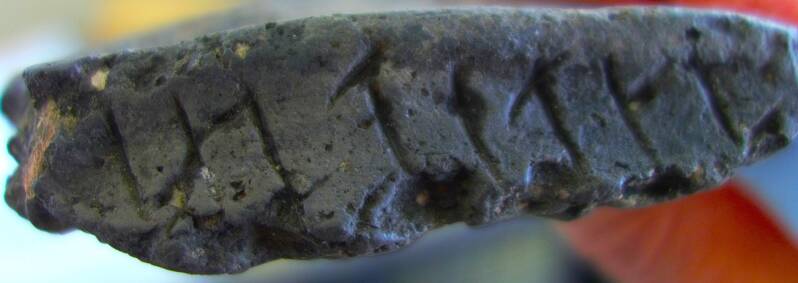
Photo below: a drawing I did of the Tipton Inscription from Tipton Mound 3. Reading left to right, there is one symbol that looks akin to a backwards runic "thorn" letter, to the right of which is a more complex symbol, to the right of which is a 7-like symbol, very close to symbol B (and to the not-yet-mentioned symbol D in the photo above, when reading left to right). The fourth symbol below, when reading left to right and not including the comma like symbol, looks very similar to a "reversed" form of symbol A in the image above, whilst the most-right symbol shown below, although from a reversed angle, shares "some" similarity to symbol F in the photo above. Some of the symbols in the inscription shown in the drawing below, do also have some similarity to certain symbols of the Cherokee Script. It is also noteworthy that Haplogroup X is found in Orkney at relatively high percentages, and in both ancient and modern Native American peoples, which is something I have discussed other aspects of in detail elsewhere.
I have also discussed elsewhere other examples of where hieroglyphs or other forms of written language have reputedly been found in connection with mounbuilders and with "giants" in North America. The examples of this are kind of numerous, and I have only discussed a small number of them. In a YouTube video (I think from the Megalithomania channel) I once saw a photo presented of some of these symbols found I think in a cave. I have since been unable to locate the video, but have discussed a little on it in another publication. I have a friend also who is currently researching connections between the Mi'kmaq hieroglyphs and those of central America, not to suggest a common system, but he certainly is suggesting that the Mi'kmaq hieroglyphs come from something much older. You might also find an unrelated, recently published blog post I wrote, published on a different website, interesting, and it helps to give some brief overview and new research goals and new information, with regard to my studies on ancient writing (particularly cave writing and apotropaic markings) in Europe, which I have also discussed extensively across a lot of other publications; the aforementioned blog post can be reached via the following link: https://www.languages-of-linnunrata.co.uk/3348946_more-on-cave-markings-in-n-england-publ-02-09-2026 .
I hope that this article was an interesting read. The upcoming Silly Linguistics article will again feature more information very relevant to the subjects in this article on this page. This article (the article on this page, with different content to the upcoming Silly Linguistics article) is dedicated to the Moundbuilders, to the Yuchi, Natchez and to the ancients of the Orkney Islands. Blessings.