j1. More Tiree flints & mystical landscapes,& more on polyamory &the Attecotti, publ. on 18/06/2026
Written and published by Linden Alexander Pentecost, officially published on the 18th of June 2026. This article is unrelated to and separate from any and all of my other publications, including being separate from those other unrelated recent publications wherein I discuss other things connected to polyamory, the attecotti, and to ancient Scotland and Tiree, sometimes connected to each other but often not. This article also contains 6 photos which I, the author took and which also, like this article in general, have not been published previously or elsewhere, nor will they be. This article was published in the UK and only on this UK website, I, the author am also from the UK and live in the UK. No AI was used in this article nor in any of my written works. This article contains 2188 words. This article is written from a personal perspective but also contains valueable historic, philosophical and love-related information, presented in a personalised way according to how I have experienced the aspects of the things in question which I discuss here.
I decided to go back to Tiree a few weeks ago. I had planned to go back for nearly 3 years, so I could record examples of the Gaelic spoken on the island using audio equipment. Sadly my trip did not exactly go as planned, but I nevertheless learned a lot more and have come to understand a lot more which I will discuss here.
I thought about going to Japan. But, as I have already published about elsewhere in unrelated contexts, I had this kind of vision when sat in the garden one day in early May, with bright sun, when my eyes were closed, I suddenly found myself on a beach and seeing colours and light as though in a third-eye vision. I was walking along the beach and my arms were outstretched like wings. I felt like I was flying. I was smiling and joyous. The sun danced on the sand. The sky and air was a thick turquoise, and I was walking towards some rock formations at the end of the beach.
I came to think that the beach I saw looked very much Tràigh Bhì on the island of Tiree. When I last went to Tiree three years ago approximately, I went to Tràigh Bhì but did not walk on the beach itself, but rather visited some ancient sites on the Hynish side of the beach, which I have discussed in other publications. This is where I went to Dùn Hiader early in the morning, and then felt a strange urge to go down to the beach, where I came across a large number of worked prehistoric flints.
This second, more recent trip to Tiree in 2026 was not that easy if I am honest. It was a bit of an emotional rollercoaster, primarily because of romantic things in my life. I also developed a cold after cycling in very wet weather on the island. I managed to visit a lot of ancient sites in general on the island, but in this article I only want to focus on what I found around Hynish and Tràigh Bhì - and excluding the flints I already found there in 2023 and much more which I have published about elsewhere.I have also published elsewhere in several places about different aspects of the mythology of Tràigh Bhì and Ceann A' Bharra, which I have published across many other publications, not in this one in front of you.
Photo below: Tràigh Bhì in the evening light, seen in a way somewhat akin to how I saw the beach through the third eye experience, although of course the third eye experience was not the same as physical reality, the light etc was in many ways different, and I will also return to this beach. Nevertheless notice the beauty of the light in the sky and on the sands in the photo below.
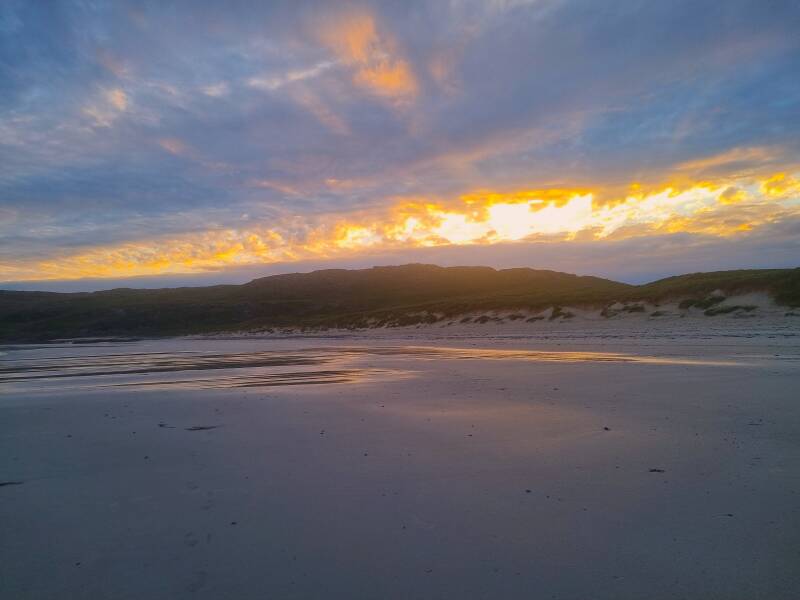
On maybe my third full day on Tiree in 2026, I finally made it to Tràigh Bhì. I felt a bit emotionally distraught. I messaged someone. Then messaged a friend back in England. I drank some cider and sang some songs as I walked along Tràigh Bhì, westwards towards Kenavara/Ceann A’ Bharra, the steep rising headland and mountain, aspects of which in terms of mythology and archaeology I have also discussed in detail elsewhere.
I headed along the beach to the area of rocks which I had been walking towards in my vision. I got there and felt a strong atmosphere. It reminded me of the way I had first felt on parts of Barra when I was 18, but I felt it in parts of Tiree too, like this place at the western end of Tràigh Bhì. I thought there might be a cave there, but I couldn't see one. I had a feeling that at least in some sense there was an “entrance” to the otherworld among these rocks, or to a world of the ancient spirits, and perhaps there is a physical cave hidden there, somewhere, perhaps not.
I looked at an area of mud beneath the area where I thought the cave might be. I remember saying or thinking to myself loudly as I became aware of how the place felt: “but I haven't found any flints yet this time… oh wait”, with the “oh wait” part being thought literally as I stared at the mud and lifted a piece of prehistoric worked flint from it. Basically, I found my first flint at the very moment I was saying matter of a fact to myself “but I haven't found any flints yet”.
Photo below: a small sample of some of the worked flints which I found at the western end of Tràigh Bhì. Experts on flints can probably tell something of their age by looking at the photos.
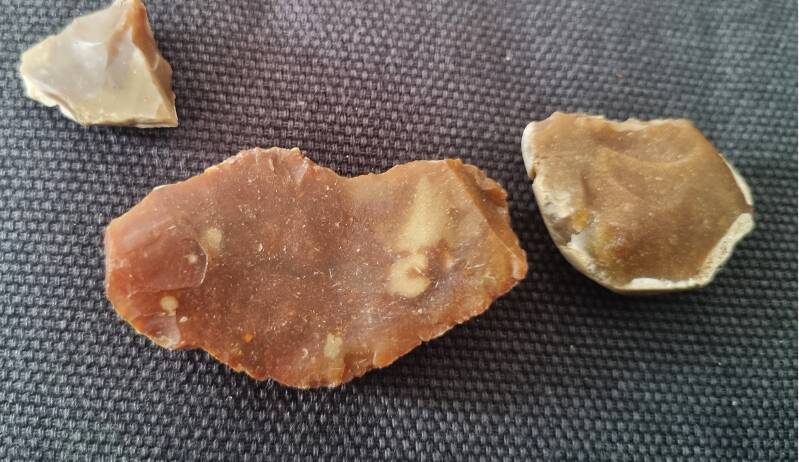
I wandered along some further, out towards the headland, but not far. I noticed several stone embankments and similar long grave-like features, similar to the “giant grave” like feature I had seen beneath Dùn Hiader back in 2023, which I also discussed in other publications. In these areas I found many more pieces of worked flint, and I found larger pieces the more I went towards the headland.
I wanted to go back there another day on my visit, but I did not.
The next day I visited a ancient and largely ruined dùn not far from the Hynish centre, south of Mannal and Balemartine. I had not visited this dùn before either, and had not originally planned to go there. At first I went down to the beach at Mannal and played a harmonica that my grandad gave me, and sang some songs in Gaelic. I then walked down the beach, mysteriously seeing some arrows in the sand which were pointing towards the Hynish Centre, obviously the arrows were not put there for me, but I took it as a sign nonetheless.
Photo below: the four cormorants sat upon a skerry near Mannal. I also played the haromonica for them, which I do not mention in the main text. How majestic they look with the hazy, misty sky behind them, yet the sky also has a powerful brightness.
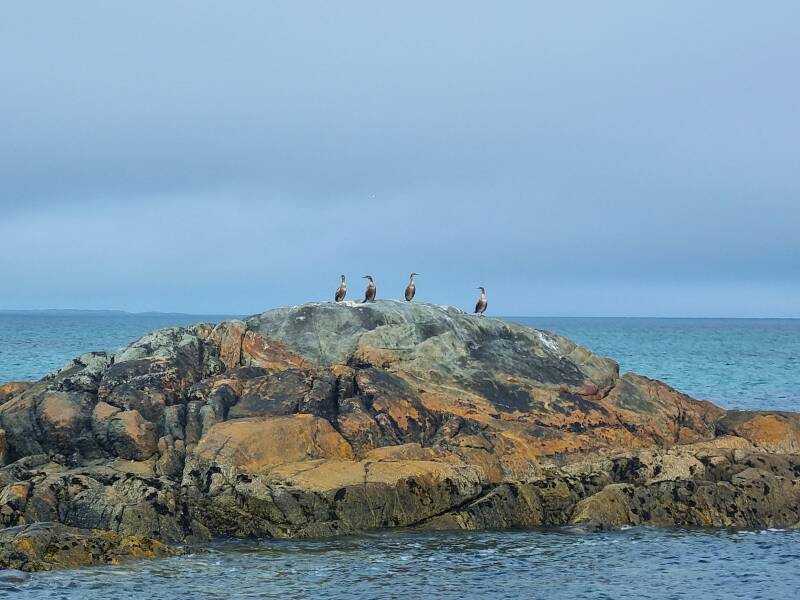
I went past a rock where four cormorants were sat, sunning themselves in the warm sunlight, even if obscured by a hazy sea mist. The image of these cormorants made me think of the tales in Scotland and Norway of cormorants leading the way to mysterious islands in the otherworld. A lady also told me that they had felt the presence of mermaids on the shores of this part of Tiree, and that they could be dangerous. I also discussed many things like this with others I met on the island on this trip, as I have already discussed elsewhere.
When I got to the Hynish Centre, I went southeast, approximately, towards the dùn. Be very careful of these kinds of places because massive chasms appear out of nowhere, even when they can seem very shallow until one is right next to them. This place also felt like it had a similar vibe to the western end of Tràigh Bhì where I had been the day before.
I was thinking about polyamory a lot whilst I was at this place. I was thinking how actually it could be negative for humans, and that perhaps the ancestors who practiced it, the “giants”, whether physically or metaphorically and in terms of their magic - were not like us in some respects.
I contemplated how the human mind cannot simply concentrate on more than one thing at once. Not really. Not to the same degree. And I contemplated how when people become interested in polyamory nowadays, I feel it often comes more from a desire to disengage from emotional vulnerability and from the magic of romantic love, rather than embracing it. Essentially, I was contemplating how people generally seem to engage with polyamory, I feel, in a way that doesn't quite match their innermost feelings.
Photo below: the area of rock outcrops and dangerous chasms at the dùn near the Hynish Centre on Tiree, note the mysterious but beautiful atmosphere, note also the dangerous chasms, one of which is visible approximately centre image but slightly to the left.
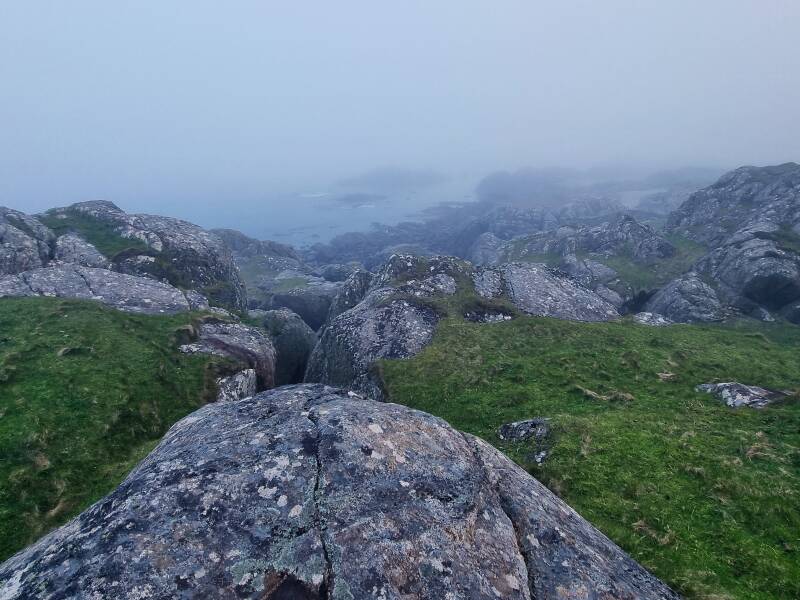
And I contemplated these ancient cultures, like the Attecotti in Scotland who practiced polyandry, the giants in Norse mythology - who also practiced polyamory according to some, the giantesses of Eigg and Skye, did they practice it too? I naturally also contemplated how the ancient dùn I was at near the Hynish Centre might also have been occupied by the same ancient, magical cultures who practiced polyamory - according to some sources at least. As I have commented elsewhere, is it just a coincidence that the Majos of Lanzarote also practiced polyandry, and that they also built at least one structure resembling a broch, like those of Tiree?
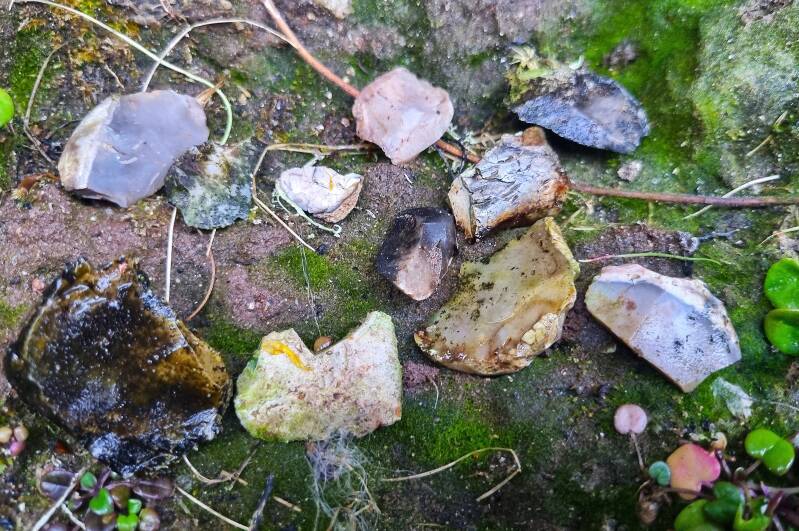
Photo below: a collection of some of the worked flints which I found in a chasm (by accessing this one safely) below the dùn near the Hynish Centre. Note the variety of colours, again, experts on flints and on the prehistoric flints in the Hebrides will likely be able to gleam something relevant from this photo as well.
I contemplated how, for humans to experience polyamory like they did, it must in some way involve a “breaking” of a bubble. A monogamous adult might see two adult partners and be unable to concentrate fully on more than one at a time. Whereas if such a bubble in perception is broken, perhaps the adult could look at the two other adults, recognise them both as individuals but at the same time relate to them both as one in terms of the flow of their energy and even at intellectual and romantic levels too. For someone to perceive like this I feel that their energy needs to flow outside of this normal bubble and to create new patterns, without losing any of its coherence or substance. This is similar to the idea of a kundalini awakening which expands beyond the spine, as I discussed in an unrelated blog post published the other day.
Anyhow, I very carefully explored numerous cracks and crevices around the base of the dùn, and in one of these cracks I came across a large number of worked flint shards. Again, it felt as though I was lead there.
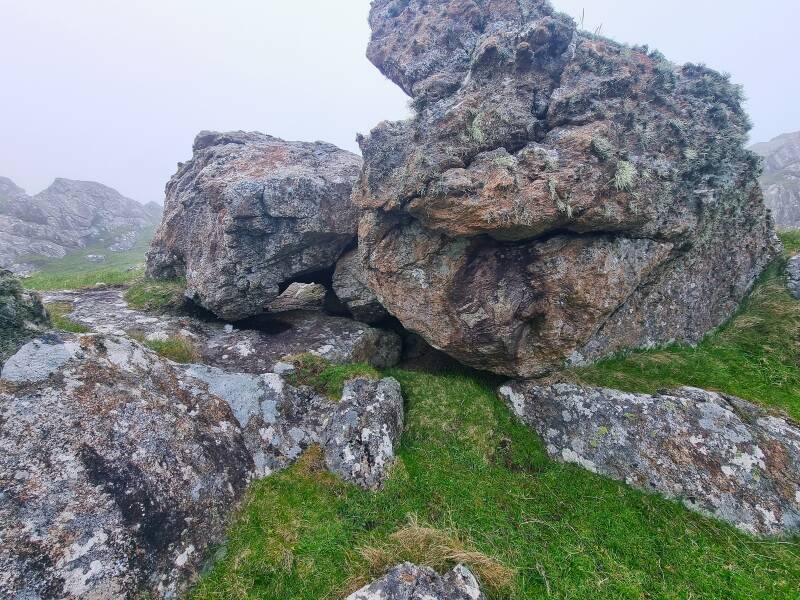
Photo below: a curious rock formation formation close to the dùn near the Hynish Centre, could this rocks have ended up like this deliberately, or were they altered as a part of this ancient site? Again, behind where the photo is taken and also elsewhere closeby are many dangerous chasms, and great care is needed.
Note that I have discussed other spiritual and other things related to my recent trip to Tiree in other unrelated recently published publications recently. I have also discussed and published about a lot of unrelated things things related to polyamory recently in other recently published publications.
The flints which I found are currently in the safe keeping of Tiree's archaeological experts. I am not sure of their possible date, but pre-Iron Age is possible, I hope to find out in the future. I hope that this article was a fascinating read. It is dedicated to the people of Tiree and to their ancestors. This article is also dedicated to our human need to be loved and to love, and to all those who need it the most. I am also grateful for the things I recount and describe in this article. Note that I also discussed other flints in an unrelated article with photos of different flints a little while back, flints from a place in Lancashire, the aforementioned article being about an archaeological site there and being on a separate website to, as well as being completely separate from, the article on this page which discussed flints on Tiree, Tiree, ancient history and polyamory.